

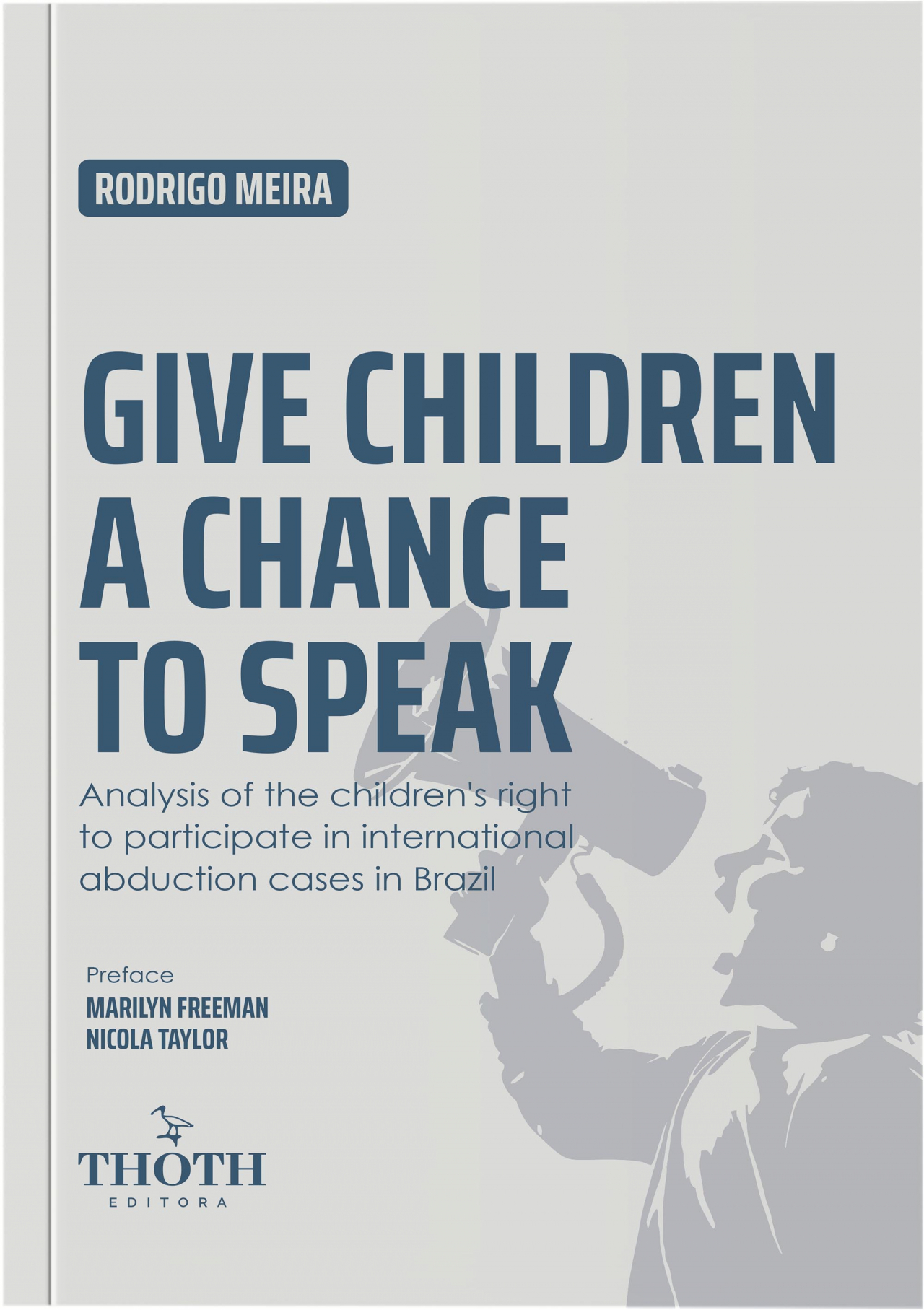
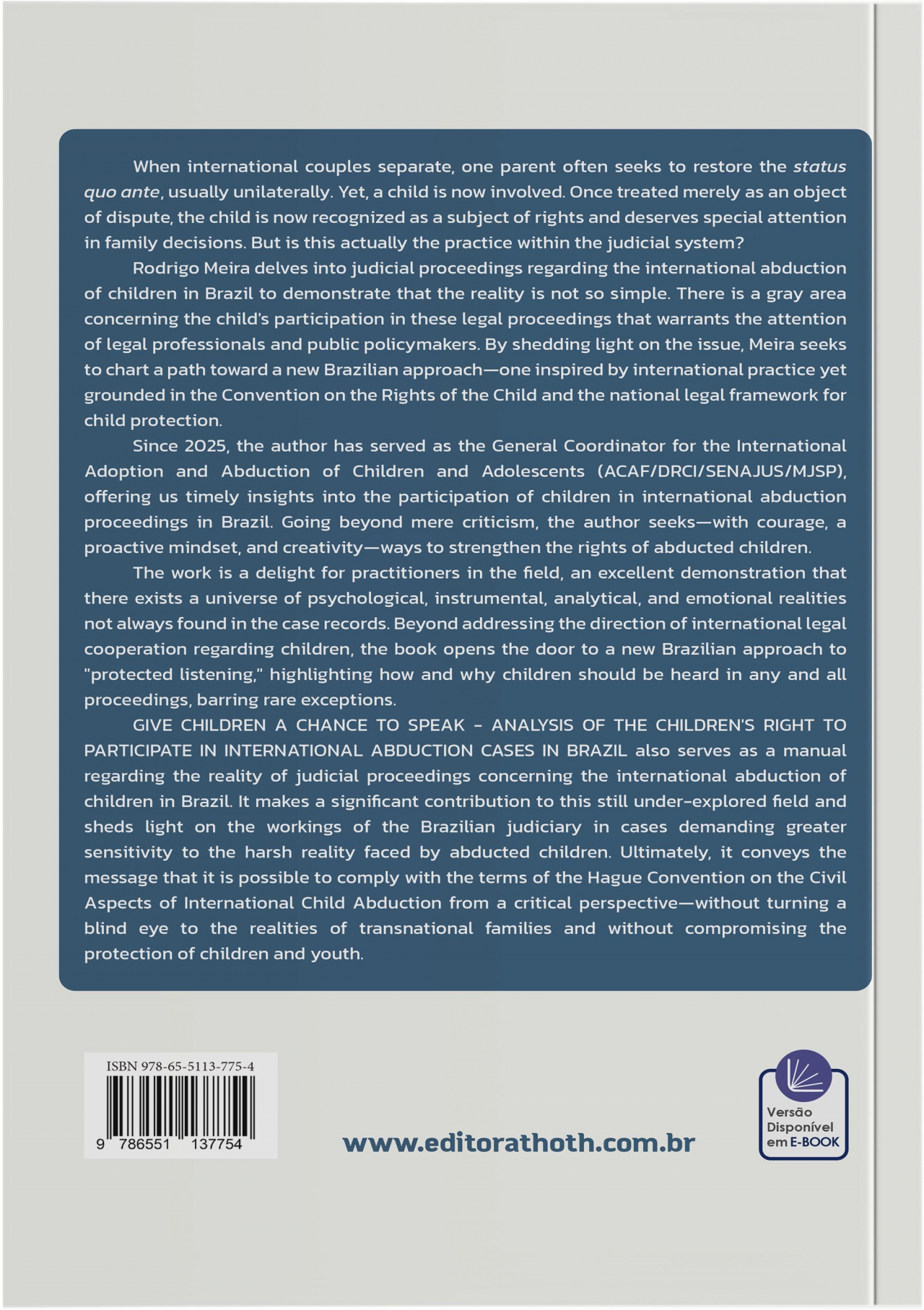
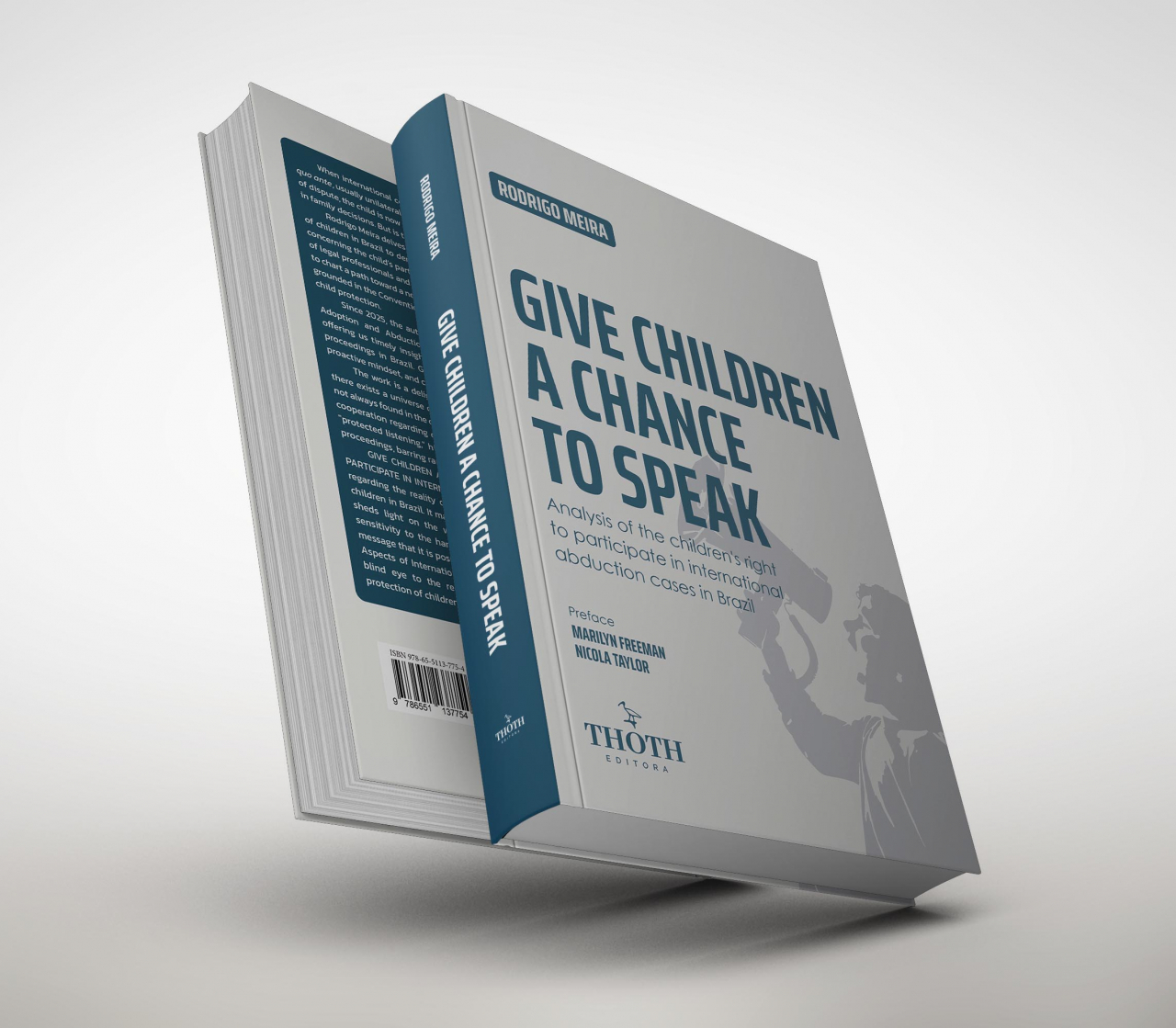
When international couples separate, one parent often seeks to restore the status quo ante, usually unilaterally. Yet, a child is now involved. Once treated merely as an object of dispute, the child is now recognized as a subject of rights and deserves special attention in family decisions. But is this actually the practice within the judicial system? Rodrigo Meira delves into judicial proceedings regarding the international abduction of children in Brazil to demonstrate that the reality is not so simple. There is a gray area concerning the child's participation in these legal proceedings that warrants the attention of legal professionals and public policymakers. By shedding light on the issue, Meira seeks to chart a path toward a new Brazilian approach—one inspired by international practice yet grounded in the Convention on the Rights of the Child and the national legal framework for child protection.
When international couples separate, one parent often seeks to restore the status quo ante, usually unilaterally. Yet, a child is now involved. Once treated merely as an object of dispute, the child is now recognized as a subject of rights and deserves special attention in family decisions. But is this actually the practice within the judicial system? Rodrigo Meira delves into judicial proceedings regarding the international abduction of children in Brazil to demonstrate that the reality is not so simple. There is a gray area concerning the child's participation in these legal proceedings that warrants the attention of legal professionals and public policymakers. By shedding light on the issue, Meira seeks to chart a path toward a new Brazilian approach—one inspired by international practice yet grounded in the Convention on the Rights of the Child and the national legal framework for child protection.
About the Author
Acknowledgements
Preface
List of Abbreviations
Introduction
PART I
THE RESEARCH PROCESS AND LEGAL FOUNDATIONS
CHAPTER 1
DATA COLLECTION
1.1 Introduction
1.2 Quantitative research and requests for access to confidential
judicial proceedings
1.3 Qualitative research: a study of data from case files and
interviews
1.4 Respect for the Privacy of those Involved and Additional
Precautions
1.5 The limitations of the research
1.6 The Profile of the Cases
CHAPTER 2
THE CONVERGENCE OF PRIVATE INTERNATIONAL LAW AND THE CHILD’S
FUNDAMENTAL RIGHT TO PARTICIPATE
2.1 Introduction
2.2 The Right to Be Heard under the Convention on the Rights of
the Child
2.2.1 Hart’s participation model
2.2.2 Lundy’s participation model
2.3 The meanings of participation in CRC
Conclusions of Part I
PART II
THE SOCIAL POSITION AND SUFFICIENT MATURITY
CHAPTER 3
THE CHILD’S PARTICIPATION IN AN ADULT-CENTRIC JUDICIAL SYSTEM
3.1 Introduction: The Best Interests of the Child in Theory versus
the Best Interests of the Participating Child in Judicial Practice
3.2. Essential Concepts
3.2.1 Adultcentrism
3.2.2 Social Position
3.2.3 Sufficient maturity
CHAPTER 4
INTERNATIONAL BEST PRACTICES FOR HEARING CHILDREN
4.1 The project of hearing children in Israel
4.2 The European Union’s Experiences
4.3 The experiences of the United Kingdom, the USA and Australia
4.4. South American experiences: Argentina, Uruguay and Chile
4.5 The Atala Riffo and Daughters V. Chile Case (2012):
Conventional Parameters for Respecting the Child’s Voice
Conclusions from Part II
PART III
THE PATH TO CHILD PARTICIPATION IN THE PROMPT RETURN PROCESS IN
BRAZIL
CHAPTER 5
RESPECT FOR THE CHILD’S VOICE IN BRAZIL
5.1 Procedures that silence the child’s voice in international
abduction court cases in Brazil
5.2 The expert report and its issues
5.2.1 The current modus operandi: the inadequacies of judicial
practice
5.2.2 Detecting influence on the child’s statements and procedural
precautions
5.3 The representation of the child in court: the Public
Defender’s Office acting as Special Curator
CHAPTER 6
HOW CAN THE SPECIAL TESTIMONY PROTOCOL BE APPLIED TO CASES OF
INTERNATIONAL CHILD ABDUCTION?
Conclusions from Part III
Final Remarks
References
Annex
| ISBN | 978-65-5113-775-4 |
| Dimensões | 23 x 15.5 x 1 |
| Tipo do Livro | Impresso |
| Páginas | 259 |
| Edição | 1 |
| Idioma | Inglês |
| Editora | Editora Thoth |
| Publicação | outubro/2026 |
Você também pode gostar destes produtos:



Acessar Conta
Esqueceu sua senha?
Digite seu e-mail abaixo para iniciar o processo de recuperação de senha.
É pai de Miguel e Milena e casado com Laura. É graduado em Direito pela Faculdade de Direito do Recife (UFPE, 2002), foi Escrivão de Polícia Federal (2003-2010), Oficial de Inteligência (2010-2013) e Registrador de Imóveis (2017-2018). Atualmente, como Analista de Comércio Exterior (2013 ao presente), exerce a função de Coordenador-Geral da Autoridade Central Administrativa Federal (ACAF/DRCI/SENAJUS/MJSP). Tem curso de Escuta Protegida e Mediação Extrajudicial. Tem pós-graduação em Relações Internacionais (UnB), Direito Notarial e Registral (Uniderp/Anhanguera/LFG), mestrado em Relações Internacionais e Direito Internacional (ambos pela UnB). É Doutor em Direito Internacional pela UnB. É autor da dissertação "O Paradoxo da Criança Adaptada: Crítica à Aplicação da Convenção de Haia de 1980 sobre os Aspectos Civis do Sequestro Internacional de Crianças no Brasil (2018)", da tese “LUGAR DE FALA E MATURIDADE SUFICIENTE: interpretando o melhor interesse pela participação da criança nos processos de subtração internacional no Brasil”. É autor do livro The Long and Winding Lawsuit e agora desta obra.